In the beginning was the tribe. And the tribe flourished and became great. In times of trouble, or concern, the tribe turned to the old men for advice, for the old men had lived long and were wise. They had experienced all the great world had to offer, both good and bad, and knew best how to deal with every eventuality.
When the young men and women of the tribe were in trouble the wise old men would speak to them in soft tones, explaining how best to overcome their woes. The wise men made rules for the young people of the tribe to live by, that their lives may be better and those of their children.
And the tribe flourished.
Then, certain of the young men rose up and said, “We do not need these old men to tell us how to live. They are old and weak, and we are young and strong. Let us run the tribe ourselves, and cast out the old men that they bother us no more.”
And so they persuaded the tribe to send the old men away, and the young men ruled the tribe. They changed the laws to suit themselves. They became greedy and stole from others of the tribe that they might become more powerful, until the tribe turned on the young men, saying, “We don’t want you ruling us, for you are uncaring of us, and steal from us that you might be rich and powerful and control us.”
So the young men made weapons and used those weapons to attack the tribe to control them. And the tribe scattered to all four corners of the Earth, to escape the greedy young men who would steal their possessions. But the young men went after them, to control them.
And the old men of the tribe saw what had come to pass, and nodded sagely to each other.
Barack Obama, like many other presidents before him, members of Congress, and most of the American people, just don’t get it. Everytime there’s an attempt to bomb this country, however vague and amateurish it might be, they run around like headless chickens, panicking, wondering why on earth this is happening to them. The media hurtles into overdrive with its crazed, “Be afraid, be very afraid,” headlines, and frenzied news anchors. Even the most minor of incidents results in the inevitable cry of, “Why us?”
No-one stops to reflect. Americans are so busy being self-righteous, considering themselves the elite of the world, that they never, for a moment, turn to a mirror and view themselves as the rest of the planet sees them. In particular, those nations who live under the US military jackboot.
Every time Mr or Mrs America dons a new shirt or a pair of shoes; straps on a wristwatch, or purchases a new saucepan; orders new tires for their fancy car[1] or fills its fuel tank with cheap gasoline, they do so on the misery, poverty, and suffering of millions in countries they’ve likely never even heard of.
Their military, of which they’re so proud……
…..have bases on every continent, except Antarctica, and occupy over 160 countries. The brutality of the US military is well documented, with frequent and regular violations of international conventions and the laws of common humanity. Mistreatment and slaughter of innocent civilians in occupied countries is now routinely recorded as ‘collateral damage’.
In 2004, Chalmers Johnson, writing for CommonDreams.Org, stated:
Once upon a time, you could trace the spread of imperialism by counting up colonies. America’s version of the colony is the military base. By following the changing politics of global basing, one can learn much about our ever larger imperial stance and the militarism that grows with it. Militarism and imperialism are Siamese twins joined at the hip. Each thrives off the other. Already highly advanced in our country, they are both on the verge of a quantum leap that will almost surely stretch our military beyond its capabilities, bringing about fiscal insolvency and very possibly doing mortal damage to our republican institutions. The only way this is discussed in our press is via reportage on highly arcane plans for changes in basing policy and the positioning of troops abroad — and these plans, as reported in the media, cannot be taken at face value.
Marine Brig. Gen. Mastin Robeson, commanding our 1,800 troops occupying the old French Foreign Legion base at Camp Lemonier in Djibouti at the entrance to the Red Sea, claims that in order to put “preventive war” into action, we require a “global presence,” by which he means gaining hegemony over any place that is not already under our thumb. According to the right-wing American Enterprise Institute, the idea is to create “a global cavalry” that can ride in from “frontier stockades” and shoot up the “bad guys” as soon as we get some intelligence on them.”[2]
The term, ‘America’s global footprint’ has been repeated so often in the media and by politicians, it has become a byword for all that makes Americans proud of their nation. The invasion and subjugation of weaker countries, innocent of any threat to the US, is accepted and applauded with all the vigor of a home-team win at any local baseball stadium.
There is only one reason for America’s attempted subjugation of the planet. It has nothing whatever to do with that oft-splurged rhetoric of president or senator: ‘keeping the homeland safe’.
Cheap goods, cheap fuel, and a steady flow of cash into the pockets of rich and powerful Americans is the sole objective of US imperialism. The Walton family of Walmart infamy owns as many dollar bills as the lowest 41% of the American populace between them. They want to keep it that way.
These rich and powerful US citizens have ruined the economy at home by throwing thousands out of work and moving their industries to third-world countries where workers get paid a pittance, and live in abject poverty, for goods that make the ‘Capitalists’ healthy profits on the US market.
Any rebellion by those in economic slavery at the hands of this ‘superpower’ is rapidly quelled by the US military, from its convenient base just down the road. Those posing too great a threat, particularly countries still managing to resist the invasion of its territory by the aggressor, are kept in check by the politics of a US-owned UN, or the intervention of so-called ‘US allies’ armed and financed from Washington.
In the Middle East, the most important of these is Israel.
The Israeli-Palestinian situation is not the prime cause for US resentment in that area, but it is a constituent of the fuel that fans the flames. Successive US administrations have tried to find a solution, but never succeeded; not that there isn’t one, but because Israeli interests are much more important to US military and economic strategy than a bunch of impoverished Palestinians walled up in Gaza or the West Bank.
Only yesterday, the following headline appeared on the BBC’s website:
US TO FUND INSTALLATION OF ISRAELI ROCKET SYSTEM”
Barack Obama is to ask the US Congress for an extra $200m in military aid to help Israel get a short-range rocket defence system in place.
The system is designed to shoot down mortars and rockets from Gaza or Southern Lebanon with guided missiles.
The system, called Iron Dome, has gone through testing and installation will start later this year.
According to US State Department figures, direct military aid to Israel was $2.55bn in 2009.
This is set to increase to $3.15bn in 2018. [3]
Meanwhile, in New York City, or Detroit airport, or almost any high population density city in the United States of America, crude bombs are being found. No-one has yet died from these devices since 9/11, (which was, of course, the biggest ‘bomb’ of all – so far).
And every time another one is discovered Americans look puzzled, stare questioningly at each other, and ask, “Why?”
As the manufacturers of this cosy little number tell us:
“From Womb to Woombie…
…because you both deserve a better nights sleep![1]
The Woombie is a proud winner of the PTPA (Parent Tested Parent Approved), Moms Best and Creative Child Awards. We have been seen on television, in numerous popular baby magazines and are endorsed by Doctors, Doulas, Postpartom Baby Instructors, Nurses and countless moms and dads worldwide. In a nutshell, The Woombie is a great easy swaddle for babies with the Startle Reflex & who are in need of a cozy yet gentle confinement.”
“…..for babies with the Startle Reflex?”
Every normal baby has a startle reflex.[2] The Woombie is basically no more than a miniature human restraint system. There’s even a ‘Houdini’ version for that little escapologist in the family.
Now, I’m no Doctor Spock, and maybe all those “…..Doctors, Doulas, Postpartom Baby Instructors, Nurses and countless moms and dads worldwide….” will skit if I say I don’t fancy any kid of mine starting life in a restraint. Call me old-fashioned, but I could never sleep in one of those things, so why expect it to be right for baby?
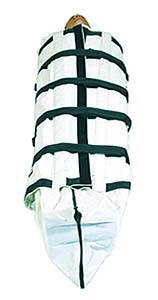
On the other hand, maybe it will prepare our kids for later in life, when they may end up in one of these:
This is the ‘Restra2 Full Body Restraint System’ from PX Direct.[3]
PX Direct sell to ‘Correctional Facilities, Production Companies and the General Public’.
The Full Body Restraint System is made of heavy duty rip-stop nylon mesh fabric which allows for total air flow and helps prevent heat exhaustion.”
Not too dissimilar to the ‘Woombie’, then?
The ‘Restra2’ is available to anyone for a mere $895.00. It’s somewhat more expensive than the ‘Woombie’ but, unlike that item, it will accommodate a full-size meddling grandma, over-sexed husband, or persistently nagging wife.