
web analytics

Pagbag Anyone? Fresh From The Dumpster.

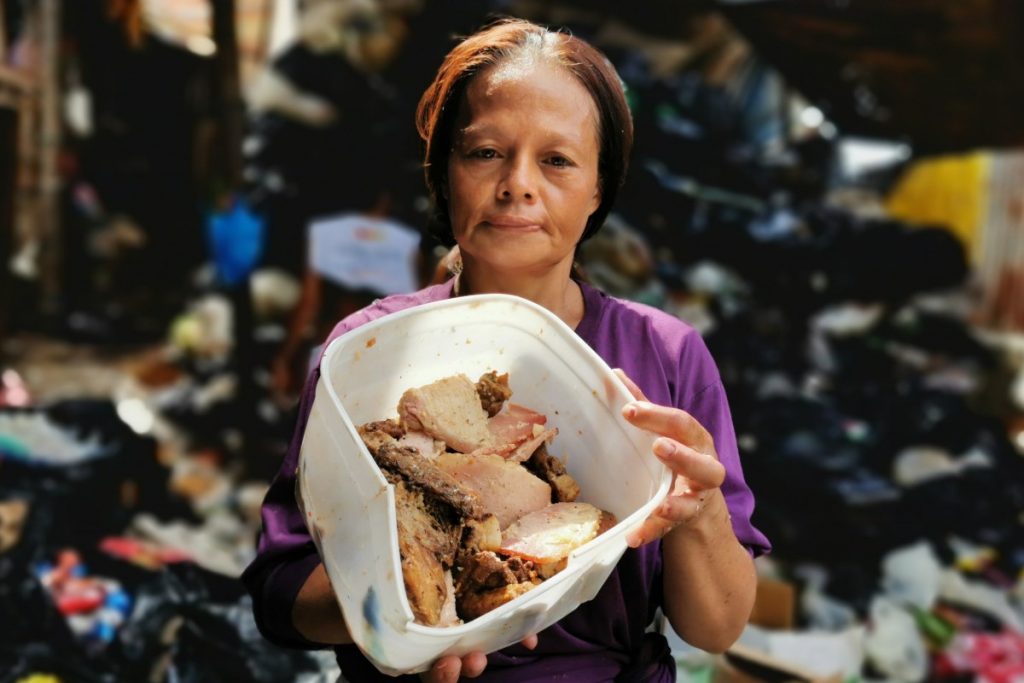
In Philippine slums, meat scavenged from dumpsters feeds those short of meals and hope. Consuming pagpag, as it’s called, leads to stunted growth in children, and heightens the risk of acquiring hepatitis A, cholera and typhoid.

Do you ever get the feeling we’re losing? Here we are nearly six months into possibly the most deadly pandemic ever, our world is spiraling to oblivion, and we’re all partying. The beaches are choc-a-bloc, young people are raving like there’s no tomorrow – they could well be right! – and our politicians are behaving like the common cold has gone a bit rampant this year and caused a few inconveniences.

What’s the major news items of the moment? The grief of people who can’t go on vacation, or might have to quarantine for two weeks when they return; the poor old airlines struggling to make ends meet because no-one can use them anymore.

Sidelined are the thousands, possibly millions, now without jobs and little or no means of support. Government handouts are for the few who fall into the rules. In France hairdressers, beauty parlours, small everyday businesses not in the hotel, holiday, or catering industries, are unable to claim anything for their losses despite customers not spending on such luxuries because they dare not, or were not allowed, to leave their homes during lockdowns.

It’s not just in France. In America the great one-off roll-out of $1,200 per person was great to receive in April or May. It was two weeks wages for the average American. There’s been none since – three or four months later.

Yet Americans can count themselves lucky, the French should be ecstatic. There are many parts of the world where this pandemic is causing so much additional financial hardship a little suffering in the West is something of a luxury.

Asia is particularly hard hit.  The Philippines, home to nearly 107,000,000 people with roughly one third living below the poverty line pre-Covid-19, has been badly affected. American-owned call centres are one source of income for the more fortunate Filipinos. Ten hour shifts through the night, with one day off a fortnight unpaid, is standard work practice. For that they earn around 12,000 pesos a month. It sounds a lot, until you realise 12,000 pesos equates to fractionally over €200 (US$245; £188) per month, or €0.87; (US$1.03; £0.79) an hour. Even that’s above the minimum wage of 375 pesos/day, as declared by the present “freely-elected” dictator of the Philippines, Rodrigo Duterte.

Most shop work and general factory work is minimum wage, which for an eight hour day equates to under 47 pesos an hour, or €0.82 (US$0.97; £0.74) or €33 (US$39; £30) per 40 hour week.

The so-called civilised nations of the West continue to grow fat on the hard labour and often near starvation of the Filipino people.

Below is an image of a typical street in Jasaan, on the southern island of Mindanao in the Philippines. Ramshackle housing, corrugated iron roofs that stifle in the intense heat. No air conditioning here. Most residents are lucky if they have an electric fan.

And THAT was all before Covid-19 struck.

Duterte ordered a complete lockdown, with instructions that anyone breaking curfew should be shot.  Thousands of Filipinos were thrown out of work as shops, factories, call centres, all shut down. Food distribution was patchy at best, reliant on often corrupt local authorities who lined their own bellies and kept the best for themselves. For most Filipinos there was no food, no money, and an imminent prospect of starvation. Many lost electricity when bills were left unpaid.

Meanwhile, President Rodrigo Duterte slums it here, in the presidential palace:

They call them dumpster divers.  Duterte has threatened to have them shot. They eke out a living collecting items thrown into rubbish bins.

They sell or exchange what they collect for food or other essentials. On average they may make 1,000 pesos a week (€18; US$20). That was before Covid-19. To stay safe from Duterte’s gunmen the dumpster divers worked at night. Now, with a lockdown curfew, even being seen on the street could fetch them a bullet. [1]

It’s so easy to forget the starving people in the world. They’re just statistics. We shove them firmly to the backs of our minds and concentrate on how bitter we feel at not having had the vacation we’d hoped for, or where the next rave party was going to be. Even the pandemic itself is brushed aside as we flock to the beaches and leave our litter behind on the sand.

In the Philippines, or many other places, that litter could possibly be worth a peso or two. It might provide desperately needed milk for a baby, or sufficient to prevent a child from dying from starvation.

Do you ever get the feeling we’re losing? If we continue on this self-centred, ego trip that the so-called civilised western world has created, we’re not just losing, we’ve already lost. Our wealth has and is being created off the backs of human beings just like ourselves, except they scratch to survive from the moment they’re born until the day they die.

It’s their lot. It’s so you and I can afford the vacation we complain that we’re not able to take; or the rave we want to attend, or the beach party we enjoy, or the aeroplane ride to wherever. None of which the people who make these things possible for you or I, will ever do.

Yes, we are losing. If we do not arrest our greed and selfishness, and begin to share what we have with those who gave it to us by the sweat of their brows and the deaths of their children, then indeed we have lost.

[1] Read more on the plight of the Filipinos HERE


What Do You Call Entertainment?

Trash collectors comb through a sea of garbage dumped into the lifeless San Juan River in Mandaluyong City on April 19, 2018. Plastic pollution is a major problem in the Philippines, which is listed among the world’s worst offenders.

No, you’re quite right. There’s not been much action on Sparrow Chat for quite sometime now. To be honest I’m so sick of what’s going on in the world I just can’t be bothered to write about it. When you boil it down there’s only one problem in the world, and that’s the human beings who inhabit it. This planet was ticking along very nicely for close to four billion years, and then we arrived.

The planet’s had a few hiccups along the way, but they weren’t all bad. Getting shut of the dinosaurs was probably a good thing. Who wanted those great monstrosities strutting about eating everything in sight. But look what the planet got in exchange: seven and a half billion rampaging individuals hellbent on ransacking their own home just so they can have every darned thing ever invented to make them lazier.

There’s been a glut of TV programs of late about people who can’t, or won’t, keep their houses clean. They stuff them full of every conceivable piece of junk they can lay their hands on. TV cameras go in with people who seem to think they’ve got some weird talent for cleaning up a house, and call it entertainment. It became so popular with viewers, suddenly almost every channel had similar programs running, all competing for the dirtiest, filthiest, properties with the saddest, most inadequate, inhabitants.

Why is that entertainment? How low have we sunk that we can slouch on our sofas with our cans of lager and watch sad people being humiliated in front of us, and kid ourselves we’re being entertained?

Even sadder, and more hypocritical, is that what we are seeing on television is merely a reflection of what we are doing to our planet, our home. We’ve trashed it so much, filled it so full of rubbish and junk, killed off so much of the natural world we once lived with, that we’re causing our atmosphere to become poisoned to such an extent the planet can no longer breathe properly and support us. It’s heating up to a degree that’ll eventually consume all its rubbish, including us, by fire.

Imagine for a moment watching a clean-up programme on the TV, but instead of the ‘cleaners’ setting to work to sort out the detritus, they just turn away and say, “We can do nothing with this, it’s too bad.” Then they take a match and set the house on fire. The camera crew rush outside and film the property as it burns to the ground.

“Ah,” we think from our sofa, with our can of lager, “Now that’s what I call entertainment.”

We Could Learn From The Cows

Last week our local farmer released his cows into a field across the lane from where I live. They’d been enclosed in the barn all winter. What a commotion! They leapt about, kicking their back legs in the air and rushing around like demented things. It took a full hour before they settled down to grazing peacefully at the long grass.

Postings have been non-existent for a while, partly due to other commitments, but mainly because it seems that so much is being written about Covid-19 there seemed little worth adding to the mix. Less obvious, perhaps, is how humanity collectively is reacting to the pandemic and its effects on us.

The answer is that we’re not reacting very well. It seems that we cannot hide ourselves away for very long without needing to break out and create mayhem within our own borders.

The disgusting manner in which US police officers manhandled George Floyd causing his death, is unpalatable in any civilized nation. He is not the first black man to die brutally at the hands or guns of US police officers, so why has this death created such a reaction in so many countries, when others have generated only limited local protests?

Could it possibly be as a result of Covid-19?

For years the news has been regularly peppered with shootings in America generally, and of black people specifically. Yet even when children are gunned down in their schools by fanatics and sick individuals it fails to generate the wholesale reaction we are seeing of late over the killing of George Floyd.

It’s truly splendid to note that in Britain the call has gone out to open up the annals of history and display once and for all the hideously cruel and despicable actions carried out under the banner of the British Empire. Remnants of that ’empire’ are still alive and well today, ingrained by powerful propaganda into the minds of many Brits who consider themselves true patriots, far superior to those whose skins may be tinted differently from theirs.

DEFINITION: Patriot: (Literal) … ‘of the fatherland’

In America, uprisings throughout most of that nation have taken on a fervour never before seen in such intensity. Even ignoring Trump’s ridiculous exaggerations, there can be no doubt this movement has gained a momentum that could have repercussions throughout the whole of the United States.

As always, the lunatics on both political fringes of society have jumped on the bandwagon of anger and frustration emanating from each side of the Atlantic, to cause violence and mayhem. But it’s not just the anarchists who are running amok. In Britain, only this week, the town of Bristol was rocked when a crowd of protesters tore down a statue of Edward Colston, a slave trader from the 17th century whose company transported an estimated 84,000 African slaves to the colonies.

It’s difficult to condemn such an act, but when citizens run amok razing civic structures, setting fire to buildings, and causing mayhem, should we not consider the true implications of their actions?

We accept protests in our societies as a democratic right, so long as they’re peaceful. Rightly so, but violence in any or all of its forms we must condemn and resist. Taken to extremes the use of violence against our societies, by individuals or groups, is a stepping stone to anarchy and a breakdown of law and order, resulting in an overthrow of democratic government  (however imperfect) and the imposition of a much inferior and authoritarian regime.

When the cows of our local farmer were released from their barn, the resulting high spirits sprang from a release of pent up energy and possibly some sense of well-being that the long confinement was finally over. One sense totally lacking with these cattle was the sense of fear. Had fear been instilled in them over their winter sojourn, the resulting antics following their release would have been quite different, and far more violent.

Unlike the farmer’s cows, our lives have been filled with fear over the last three or four months of winter. Suddenly, our cosy, comfortable, lives that we’d been used to since birth, were gone. Confinement indoors, isolated, with its accompanying dread of a deadly virus emanating from the mouths of anyone who came too close, propagandized into our brains by Covid-19 twenty-four hour media news, seemed almost like the end of civilisation as we’d known it. It’s possible it was.

There’s a very real fear that life may never be the same again. The virus still lurks, picking us off one by one if we drop our guard for an instant. Will it return in force as winter encroaches again? Will we be locked away once more, like the farmer’s cows, only with the accompaniment of even greater fear next time. No happy release for us, should Covid-19 stalk the towns and cities once more.

We can do nothing about the virus. We hope the scientists will effect a cure or a vaccine. Many viruses have been eradicated by vaccination on a major scale. Yet influenza and the common cold still exist and flourish, and they are both coronaviruses, like Covid-19.

So we have a sense of high-spirits when our lockdown is lifted, but the fear is still there. Indeed, just removing lockdown increases the fear for many. Confined, we were safe. Outside, the world has taken on a strange, almost malignant, form. It’s no longer secure and safe. Death, like an invisible alien ray, lurks everywhere.

We need to make everything better. But how to do so? Then, suddenly, an explosion of fear-laden emotion blasts around America and across the Atlantic. Change is the answer! Things must change. We’ll start with the vile scourge of racism. Let’s wipe out this horror once and for all. We can’t eradicate the virus, but we can purge ourselves of other bad things.

Like the cows let into the field we have a way now to exorcise our pent up energy and emotions. Unlike the cows we still have to deal with our fear, and fear is a negative and violent emotion, particularly when instilled into populations en masse. Dealing with that fear has produced violent responses and civic unrest on an almost unimaginable scale.

The cows are a part of the animal kingdom to which we, Homo sapiens, also belong. Had the cows been fearful over winter they would have reacted much more violently on their release, just as many of us have done on ours. Without Covid-19 it’s unlikely the unlawful killing of George Floyd would have raised any more of a protest than any of the many other unlawful police killings, or mass shootings, so prevalent in America.

Perhaps, if we had only universally recognised and accepted our membership of the animal kingdom, instead of constantly proclaiming our superiority over it, and detachment from it, we might possibly have escaped Covid-19 altogether.

Science tells us the virus came about because of our destruction of natural habitats to further our greedy demands. Recognising our kinship with those creatures whose homes we’ve been decimating, may have made us think twice before doing so.


Hosted By A2 Hosting

Website Developed By R J Adams