Typhoon Haiyan is now officially the most severe weather system of its type ever to make landfall. A major nation has been virtually wiped off the map. It will take years, decades, for the Philippines to recover.
Wild fires, drought, floods, tornadoes, so severe they create new records of intensity with every year that passes, and regularly afflict the Americas and Australia. The oceans are rising and warming. Greenhouse gases are poisoning the atmosphere at a rate barely comprehensible.
And still they do nothing.
Who should the people of the Philippines blame for this ransacking of their nation? Who, or what, can they hold accountable for the sudden death and destruction that has robbed them of their families, their homes, their livelihoods?
Should they, perhaps, blame their God?
Or, should they hold responsible those who years ago were warned of the consequences of human pollution, and did nothing?
And are still doing nothing.
Those who had most to lose from legislation that, had it been enacted in time, would have averted, or at least lessened, the catastrophic weather patterns we now experience, chose to block that legislation by corruption, blackmail, and bribery of our lawmakers. In turn, those lawmakers – our politicians – turned their backs on the people and took the thirty pieces of silver showered on them by the corporate rich.
It may be human nature to blame a deity in time of tribulation, but no deity was responsible for those ten thousand dead in the Philippines, or the 170,000 who died in the tsunami of December 2004 in Indonesia…
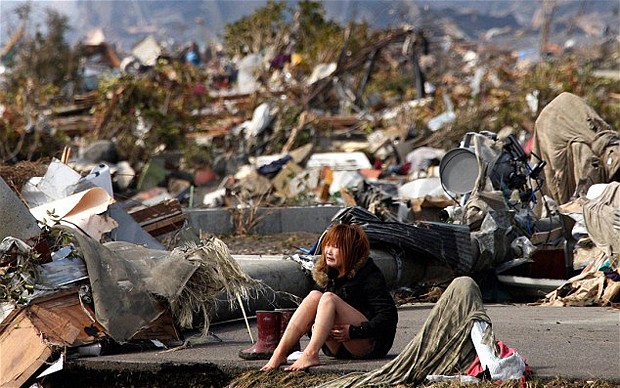
…or the 15,883 deaths resulting from the Japanese tsunami of 2011.
Mankind is wholly responsible. The greedy rich, and those who feed from the crumbs scattered from corporate dinner tables, are the real culprits. Only they had the power to do something. They did nothing. Only they had the means to turn the atmospheric tide. Instead, they chose mammon.
It will get worse. Even now, while quietly hinting at global warming as a possibility, Western media still hedges with the stock phrase, “No-one can say for sure…”.
It will come to America. It won’t be called Typhoon Haiyan, but it will come. It will create devastation on this continent such as has never been witnessed before. It will make Katrina resemble a breeze on a summer’s day.
Will they still do nothing then? They probably will, when they finally realize their own, fat, corporate hides are in jeopardy. Then they’ll get around to doing something.
Have you noticed it’s the time for sanitizing one’s legacy. Two decrepit old political has-beens have just published books designed to make us all go, “Ah, bless ‘im, he really is a nice man, after all.”
I am, of course, referring to that evil mastermind of the George W Bush years, Dick Cheney: the true president, in all but name. His latest work, “Heart – An American Medical Odyssey” is, as they say, on the bookshelves.
Mike Lofgren, a one-time Republican staffer with twenty-eight years service in Washington, writing in his book, ‘The Party Is Over’, states:
…After the September 11, 2001, terrorist attacks, the creation of the Department of Homeland Security was as much a legislative mess as it was an enduring monument to American gullibility and deliberately induced fearfulness. President Bush and his advisers, meaning Dick Cheney, did not want a cabinet department at first. Bush and Cheney preferred to keep homeland security functions under the executive office of the president, which would have made it free of legislative oversight…[p31][my bold]”
With his latest book, Cheney is trying to tell us he really does have a heart. He truly does, he purloined it from someone else who sadly wasn’t able to choose who got it.
In a recent interview with USA Today, when asked about President Obama’s ‘personal leadership, his political agenda and, especially, his handling of national security’, Cheney responded:
“His priorities are radically different from mine…I’d put defense first and foremost. The Constitution and the oath of office, the first thing you need to be focused on is defending the nation. All the highway money, food stamps and education, and everything else we like having the government do, don’t amount to a hill of beans compared to our inability to defend the nation.”[1]
Defend the nation against whom, Mister Vice President? Eighteen Saudi Arabian religious nutters hell-bent on getting their own back for your invasion of their holy land? Perhaps if your citizens were properly educated to the real truth of American diplomacy…
…and properly fed, they’d force you to remove your US jackboots from Mecca out of respect for the cultures and beliefs of others.
And, how many hungry Americans today would give their right arm for your hill of beans?
Following in the ‘I’m really a Mister Nice Guy’ footsteps of Richard Bruce Cheney is the ex Chairman of the FED, Alan Greenspan. Now eighty-seven years old, Greenspan has just published his own book, “The Map and the Territory”…
In an interview on ‘The Daily Show’ this week Greenspan refuted any idea that he knew what the banks were up to prior to the economic crash of 2008. Does he really expect us to believe that?
Steven Pearlstein, writing in the Washington Post, succinctly makes the point…
What we find, however, is that Greenspan’s journey of discovery brings him right back to where he began — to an unshakable faith in free markets, an antipathy toward market regulation, and a conviction that progressive taxes and social spending are to blame for slow growth, stagnant wages and exploding deficits.
Those who have followed his career know that it was Greenspan who gave the green light to bank consolidation, Greenspan who pushed financial deregulation, Greenspan who advocated new global rules that would have reduced bank capital reserves and Greenspan who blocked efforts to crack down on abusive subprime lending. But if you are looking for him to accept any responsibility for the crisis that ensued, you will be sorely disappointed.[2]
Here we have one of America’s top economists (if not, the top), who for thirty years was chairman and president of Townsend-Greenspan & Co., Inc., an economic consulting firm in New York City; has also served as corporate director of the Aluminum Company of America (Alcoa); Automatic Data Processing; Capital Cities/ABC, Inc.; General Foods; J.P. Morgan & Co.; Morgan Guaranty Trust Company; Mobil Corporation; and the Pittston Company (now ‘Brinks’, revenue $3.886 billion FY2011), has obviously hob-nobbed with top bankers and other aristocrats of the finance industry, yet has the gall to suggest he didn’t know what the banks were up to. Pull the other one, Mister Greenspan. Ayn Rand may have captivated your economic heart, but some of us are made of sterner stuff and less easily cajoled.
Incidentally, Alan Greenspan was also director of the Council for Foreign Relations from 1982 to 1988. A prominent member of that organization is Brian Williams, the $10,000,000/yr anchor and managing editor of NBC’s ‘Nightly News’ program.
A close associate of Williams, and one of NBC’s long-standing reporters and commentators, is Andrea Mitchell, probably best remembered for her ‘role’ in the ‘who outed Valerie Plame’ case.[3]
It’s pure coincidence, of course, but Mitchell just happens to be the wife of Alan Greenspan.
What, you might ask, has that to do with anything?
Possibly nothing. But Brian Williams, the oh-so-perfect maestro of the tear-jerking sob-story Americans love so much, is constantly referring to NBC employees as members of ‘our great NBC family’, while refraining from any explanation as to just how far-reaching the branches of that ‘great NBC family’ truly are.
Well, the Big Daddy parent of the ‘Great NBC Family’ just happens to be the General Electric Company of America.
Yes, you’ve guessed it – the wealthy relative who makes really crap light bulbs, and even crappier nuclear power plants.[see previous post].
Small world, isn’t it?
My guess is there’ll be many more, as the years creep on, who’ll feel the need to sanitize their public legacies.
General Electric is the 26th largest firm in the US and the 14th most profitable. So why can’t they make light bulbs that work?
In May this year I purchased six double packs of their ninety watt outdoor halogen bulbs for use in my security lights.
According to the pack, these bulbs will last 1.4 years. Then, the small print states that the figure is based on a usage of three hrs/day. Obviously, then, that figure won’t apply if the lights are used at night. This I found to be perfectly correct. My lights were used for six hrs/night through the summer. All twelve bulbs purchased in May are now defunct.
Given that my bulbs were on twice as long as recommended by GE, they should have lasted 1.4/2 = 0.70 years. That’s slightly less than nine months. All my twelve bulbs gave up the ghost within five months. Some lasted less than three.
“Ah, those bloody Chinese,” is the obvious response. Until one reads the pack blurb: “Assembled in the USA”. But, is that the same as “Made in the USA”? No, it just means the Chinese bits were shipped here for assembly.
One would think, given the size of the company, that by now GE would have learned how to make light bulbs.
Still, it’s only a bulb. I can always go out and buy another.
Have you noticed how Fukushima is decidedly out of the news right now? Remember the Japanese earthquake/tsunami of March 2011 that devastated whole communities, and took out six nuclear power plants that continue to pour highly radioactive water into the Pacific Ocean? It wouldn’t be surprising if you’d forgotten. The US media appears to have amnesia over the whole subject.
Which is all rather strange considering the United Nations and half the world’s atomic scientists are all rushing out to buy anti-diarrhea medicines because of it. You see, the problem with Fukushima’s six nuclear reactors is that they were badly designed in the first place. Reactor 4 is particularly critical right now. It houses about 1,300 fuel rods that, if they’re not removed safely, will cause a nuclear event roughly fourteen hundred times that of the Hiroshima atomic bomb.[1]
Reuters:
“The No. 4 unit was not operating at the time of the accident, so its fuel had been moved to the pool from the reactor, and if you calculate the amount of cesium 137 in the pool, the amount is equivalent to 14,000 Hiroshima atomic bombs,” said Hiroaki Koide, assistant professor at Kyoto University Research Reactor Institute.
“They are going to have difficulty in removing a significant number of the rods,” said Arnie Gundersen, a veteran U.S. nuclear engineer and director of Fairewinds Energy Education, who used to build fuel assemblies.
Spent fuel rods also contain plutonium, one of the most toxic substances in the universe, that gets formed during the later stages of a reactor core’s operation…”There is a risk of an inadvertent criticality if the bundles are distorted and get too close to each other,” Gundersen said.
He was referring to an atomic chain reaction that left unchecked could result in a large release of radiation and heat that the fuel pool cooling system isn’t designed to absorb.
“The problem with a fuel pool criticality is that you can’t stop it. There are no control rods to control it,” Gundersen said. “The spent fuel pool cooling system is designed only to remove decay heat, not heat from an ongoing nuclear reaction.”[2]
One major problem for the Japanese is that the pool housing these rods is over one hundred feet off the ground, and that ground is unstable, making the building prone to collapse. It’s vital those fuel rods are removed, and TEPCO, the Japanese company that owns the Fukushima plant, has stated it will begin removal next month.
There’s a problem with that. Normally, rods are removed using computer technology. They’re very close together, and it’s vital they do not touch or it could spark an unstoppable nuclear reaction. Even using computers, the process can take many months. TEPCO will be attempting to do the job manually.
One eminent western atomic scientist has already decided to move her family to the southern hemisphere, if it all goes wrong.[3]
Meanwhile, world opinion is forcing the United Nations to put pressure on Japan to allow an international team of scientists into the site to assist with this highly delicate task.
Given that the prevailing trade winds across the Pacific carry anything the Japanese eject into the atmosphere straight onto America’s western coastline, one can only hope they’re successful. So far, the Japanese prime minister, Shinzo Abe, is in no hurry to cooperate, and TEPCO have proved decidedly ham-fisted in their approach to the problem.
As stated earlier, the removal of the fuel rods is complicated by the unduly bad design of the nuclear plant. Had the building housing the rod pool been on the ground it would be less susceptible to further earthquakes, or the gradually encroaching mud that is causing the building to sink further on its foundations.
So, who can we hold responsible for designing this ‘catastrophe waiting to happen’? Is it another example of that cheap Japanese rubbish they tried to parm us off with in the sixties?
Well, no. Actually, all six Fukushima plants were designed and built by the General Electric Corporation of America, otherwise known as GE.
Remember them? The company that can’t even make a decent light bulb?
Still, it’s only a planet. We can always go out and buy another.