God luv ‘im, he cares after all! Today, George W Bush will (attempt to) leave his mark on environmental history by signing declarations under the 1906 Antiquities Act, that will create three large marine sanctuaries where fishing will be banned and divers require a permit.[1]
These sanctuaries take in Pacific waters at the northern end of the Northern Mariana Islands, including the Mariana Trench, the Rose Atoll in American Samoa — the world’s smallest coral atoll and one of the most remote – and in the central Pacific, coral reefs, pinnacles, sea mounts, islands and surrounding waters of Johnston Atoll, Howland, Baker and Jarvis Islands, Kingman Reef, Palmyra Atoll and Wake Island. These areas harbor some of the most pristine coral reefs in the world.
According to a report in the SF Chronicle, in November, the idea has induced conflict between Laura Bush and Dick Cheney, the former arguing it “would attract tourism and burnish the president’s record for history.” The vice president is concerned about the effects on local economies, in particular that of the Mariana Islands, heavily reliant on fishing – well, not anymore, apparently.[2]
It’s interesting to note, the area concerned is almost the size of California, but none of it will intrude on the activities of the US fishing fleet. Surprise, surprise.
This is not the first marine sanctuary George Bush has created. Two years ago, our environmental president named the Northwestern Hawaiian Islands and surrounding ocean as a national monument. It’s to be hoped he arranges to take better care of these latest sanctuaries, as, according to BuzzFlash.Com:
In 2006, President Bush established 140,000 square miles of Hawaiian island and surrounding ocean as a national monument, citing the need to protect the extensive reef and the 7,000 rare species living there. Two years later, officials say the clean-up efforts were better before Bush’s designation.
The provisions of the proclamation prohibit commercial fishing, place strict restrictions on ship passage and use of natural resources, and pledge to work with federal agencies to maintain and protect the sanctuary…….
The archipelago, now known as Papahanaumokuakea Marine National Monument, is plagued by huge amounts of debris that wash up on the islands’ shores. In 2005, before its designation as a national monument, the area received a $2.1 million cleanup budget. Through 2008, the Bush administration requested only $400,000 per year and though Congress has added to that, dozens of tons of debris remain.
Marine conservation experts have expressed disappointment with the effort. Elliott Norse, president of the Marine Conservation Biology Institute, said:
“It is wonderful that our nation has made a commitment, and this administration deserves a lot of credit for designating the world’s largest marine reserve, but there is a responsibility that goes along with that… Unfortunately in recent years the U.S. has not made picking up trash in our most special places in the ocean a priority.”[3]
It would seem George Bush’s greatest achievement as president (apart from catching a mythical 7lb perch) was learning to use his fountain pen. After all, it doesn’t take much effort to sign a piece of paper. What happens after, Bush seems happy to leave to someone else.
Oh, and quite why, “burnishing the president’s record for history,” should be a viable reason for taking such drastic measures, only Laura Bush can answer.
I would like to make a personal plea to the person from the above organization who recently left a comment (now deleted) on Sparrow Chat.
If you wish to enter into meaningful discussions on the value of your religious beliefs, healing as opposed to my spiritual beliefs, patient I am more than happy to do so.
I will not, rx however, allow Sparrow Chat to be used as a spam mail site for your business.
That you have to employ marketing techniques to sell your religion says little for its veracity.
Given the many protesters who turned out in Europe to demonstrate against the latest Israeli aggression in Gaza, the support in America was dismal by comparison. While the Washington Post was describing ‘thousands’[1] throughout Europe, it dwindled to just ‘hundreds’[2] in the United States.
This is hardly a surprise, given the enormous pressures on Congress, and consequently the media, by pro-Jewish lobbyist groups in the US. Those who did turn out deserve our praise and support.
In a piece of well-planned political play-acting, New York Mayor Michael Bloomberg met up with the Israeli Consul-General Asaf Shariv, a few miles south of City Hall, and displayed to waiting journalists an exploded Palestinian rocket that was purported to have killed an Israeli woman out for a walk.
Presumably, this piece of scrap metal was flown in from the Middle East especially for the occasion?
Bloomberg told reporters, “I can only think what would happen in this country if somebody was lobbing missiles onto our shores or across the border.”
Apparently, no-one bothered to suggest that had the US invaded Mexico forty years ago, occupied Mexican land by force of arms and had to suffer a resistance movement firing rockets into Texas as a consequence, it’s likely US public pressure would have forced a peaceful resolution years ago.
But, then, no-one would, would they?
There’s been so much rubbish spouted about this latest conflict, often from those who really should know better, that it’s time they got their facts right before attempting to ‘educate’ the masses.
Gaza was the subject of a truce between the Israeli government and Hamas, brokered by Egypt. It began in June 2008 and was scheduled to last six months, with the possibility of negotiations to extend it at the end of that time. As a part of the agreement, Hamas was to stop the bombarding of southern Israeli towns with rockets and mortars, and Israel would lift the blockade that had been slowly strangling Gaza for months.
It’s fair to say neither Hamas nor Israel kept to their side of the bargain. Rockets and mortars continued to be fired from northern Gaza, though at a vastly reduced rate, and the Israeli government took every opportunity to reimpose the blockade and ensure its stranglehold on the people of Gaza was maintained.
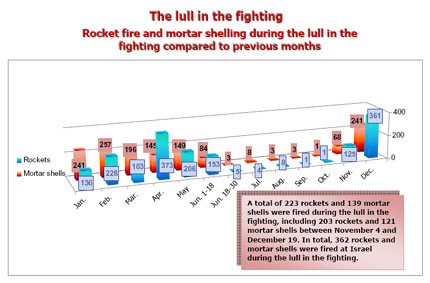
The truce began in June 2008, and as can be seen from the Israeli statistics above, rocket and mortar attacks dropped off drastically over time with only one rocket being fired during September 2008, and one in October 2008.[3]
The caption on this image is misleading. While the “lull in the fighting” was scheduled to last from June ’08 to December ’08, escalation erupted early, from November 4th. The number of rockets fired during the actual “lull” was only 19 (late June to end of October 2008) (prior to the truce, Hamas and other Palestinian organizations were firing around 10 rockets per day from Gaza). To suggest that the rocket count for the truce period was 233, is deliberately misleading, as all bar 19 of those were fired after the truce had broken down i.e. post November 4th.
What is often overlooked by media analysts is the effect of other, peripheral, groups in Gaza. The al-Aqsa Martyrs’ Brigade, among others, is a loose conglomeration of Palestinian resistance fighters (affiliated to Fatah) who also use Gaza as a launching site for their rocket attacks against Israel. The June truce may have quelled Hamas’s rockets and mortars, but Hamas had then to persuade al-Aqsa to also comply. It’s likely most of the attacks on Israel between June and October 2008 were al-Aqsa, not Hamas, inspired.
The truce was scheduled to run from June to December, but in early November it fell apart. Israeli propaganda blames Hamas, but while the Palestinian organization did involve itself in nefarious activities, which came to a head on November 4th last year, it should also be remembered that throughout the truce period Israel controlled all the cards.
The population in Gaza during the truce period (and before) can be compared to prisoners in a cell block, at the mercy of their jailers. Good behavior was rewarded with privileges; defiance incurred punishment. Whenever a rocket or mortar was fired from Gaza, Israel reimposed the blockade, closed the checkpoints, and waited while the people of Gaza starved for a while, or lived without power, or both.
Under these subjugating conditions, it’s little wonder Hamas conspired to strengthen their position against the Israelis. They hatched a plot to tunnel out of Gaza and seize an Israeli soldier, intending to use him as an additional bargaining chip with the Israeli government. November 4th was the date set for the action.
Israeli intelligence was tipped off to the plot and the tunnelers broke through on the other side of the Gaza border to find Israeli soldiers waiting for them. Seven of the Palestinians involved in the raid were shot dead.
The result was an immediate escalation of hostilities. Hamas renewed its rocket and mortar campaign and the Israeli military machine, that had been training and planning a Gaza invasion for the previous twelve months, despite the truce, prepared for invasion. Border crossings were slammed shut and Gaza was once again placed under full siege.
When the Israeli government blames Hamas for breaking the truce they are technically correct. What they fail to elucidate are the conditions forced on Gaza during, and prior to the truce, and its total dependence on Israeli benevolence – in short supply at the best of times – that was driving the people of Gaza to frustration and despair.
A number of factors led up to the present situation in Gaza. Perhaps the greatest of them, in terms of its effect on the Palestinian people, was the concerted and successful effort by the West – led by the US, on behalf of Israel – to destroy the democratically elected Palestinian government of Hamas. It sent a simple message to the people of Palestine: “Forget democracy, we – Europe, the US, and Israel – will continue to control your lives.”
The Israeli political scene is at best tumultuous. Scandal haunts the Knesset, and political daggers lurk in every shadow. With elections pending, the ruling party is doomed unless it can appease those Israelis living under the scourge of Gaza’s rockets. Preventing these attacks is not only desirable, but politically vital. It is achievable via only two routes: negotiation (never an Israeli strong-point), or military might – consistently the weapon of choice for Israel’s leaders, past and present.
Israel never anticipated a truce with Hamas would achieve results. Long before negotiating the June ’08 ceasefire it had been planning a military incursion of Gaza. The 2006 defeat of the Israeli army by Hezbollah, in Lebanon, still rankled among the Israeli people. A great victory was required to re-inspire confidence in the Jewish military machine. Where better to achieve that victory, but in Gaza against Hamas?
It’s probably fair to say that the Israeli government didn’t care one jot whether the Gaza truce worked or not. It bought them time; time to reorganize and retrain their military in guerrilla tactics. They’d observed the US army struggle in Iraq – how inept the American marines had proved to be at hand-to-hand fighting in the streets of Baghdad. Israel has always had to learn lessons quickly. One can be sure its soldiers are well-versed in guerrilla tactics as they thrust into the heart of Gaza today.
A victory in Gaza may well secure political success for the ruling Kadima party, but it will have to be a complete victory. The rocket and mortar fire from Gaza must cease permanently if Tzipi Livni is to be Israel’s next prime minister.[4] It’s difficult to comprehend how that can be achieved. Israel appears to be relying on the people of Gaza to throw out Hamas in favor of the more compliant Fatah. Indeed, Israeli military success may force that option on them.
Failure to eradicate the rocket menace will likely swing power into the hands of Benjamin Netanyahu’s hardline Likud party. That’s an option guaranteed to bring further misery to Palestine.
It seems the people of Gaza are tonight between a rock and a hard place. Unless Hamas can drive the Israeli army back across the border – a scenario best described as the tale of David and Goliath repeating itself – the thousands of good folks of Europe, and the hundreds of well-meaning US protesters, may well find they have to take to the streets many more times before the Palestinian people finally achieve what is rightfully theirs.