
web analytics

Blackmail: A Dirty Word For A Dirty Government

The British government has finally sunk to its lowest level in the latest bid to force the European Union into giving in to its demands. Ever since the vote to leave the E.U. was engineered by a group of billionaires and high-ranking politicians hellbent on handing British interests over to American corporations, the U.K. government has demanded to both have its cake and eat it. It expects to leave the Union, yet keep all the good bits it enjoyed while a member.

The European Union was founded on four core principles: freedom of movement of people, goods, capital, and services throughout the member states. Britain is now leaving the Union as of 11pm UK time on Friday 29 March, 2019. To date, no agreement has been reached and the negotiations have become increasingly acrimonious. Everything the U.K. has demanded has been in contravention of one or more of the E.U.’s founding principles.

To aggravate matters further, Southern Ireland (Eire) is a full member of the European Union, but shares a border with Northern Ireland, part of the U.K.. Under the Good Friday Agreement signed into law on December 2nd 1999, said border must remain open and free from any customs regulations. The quandary is how goods moving from the E.U. (Eire) into a non-E.U.country (Northern Ireland) can be controlled when Northern Ireland will cease to be a member of the E.U. customs union.

The E.U. negotiators expect the U.K. to find a solution to this apparently unresolvable problem and so far the British government has failed miserably to solve the issue to the E.U.’s satisfaction. Now, the U.K. government is demanding the E.U. find an answer. Understandably, the E.U. is saying why should it? It’s Britain’s problem.

Why not simply move the border to the Northern Ireland coastline with the Irish Sea? Oh, no, state the Democratic Unionist Party of Northern Ireland, they’re not prepared to accept that reasonable solution. They demand the border stay put.

Why can’t the DUP be over-ruled on the issue? They were the only political party on the island of Ireland to vote against the Good Friday Agreement. They also worked relentlessly to ensure the U.K. voted to leave the E.U., despite a strong majority of Northern Irish citizens (56%) voting to remain in the European Union. They’re also the minority party (only ten seats) in the British Parliament, but keeping Theresa May and her Tory hordes in power. Without them the government would collapse.

In desperation, this rabble of a U.K. government has now turned to blackmail. Dominic Raab…

…the government’s new ‘Brexit Secretary’ (the last one just resigned) has stated that the U.K. may refuse to pay the 39 billion pounds ($51 billion) it owes the E.U. if no trade deal is forthcoming from Europe

This from the ‘Irish Examiner’:

British Government threats to refuse to pay its £39bn divorce bill to the EU are “an empty threat” but “disappointing”, Dublin has said.

Speaking yesterday, the UK’s new Brexit Secretary Dominic Raab, a prominent Leaver, said the UK could refuse to pay its £39 billion divorce bill to Brussels if it does not get a trade deal.

Writing in the Sunday Telegraph and also speaking on BBC television, Mr Raab said there has to be an element of conditionality to the exit deal and how the UK’s future relationship with the EU is determined.[1]

There are, of course, two obvious solutions to the whole unsavoury business: either move the Irish border to the Irish Sea and stuff the DUP, or hold a second referendum. After two bitter years of squabble and dirty tricks the British people have had their fill of Brexit. A second referendum would almost certainly result in a strong “remain” vote.

Neither will happen because moving the border would mean the DUP no longer supporting the government, which would then fall, and a vote to remain would also, undoubtedly, bring down the government.

Holding onto power at all costs is all that matters in today’s politics.


[1] “Threats by UK to refuse paying £39bn Brexit divorce bill “disappointing”, Senator says” Irish Examiner, July 22nd 2018

I’m British, Embarrassed And Ashamed!

News today that John Cleese, that great comedian and star of Monty Python, Fawlty Towers, and other glorious offerings…

…is relocating to the beautiful Caribbean island of Nevis. The reason: he’s had enough of the United Kingdom and its grotesque right-wing government. I can’t say I blame him. Despite living in France, I’m close enough to my homeland to smell the stench of barely dormant fascism drifting across the English Channel.

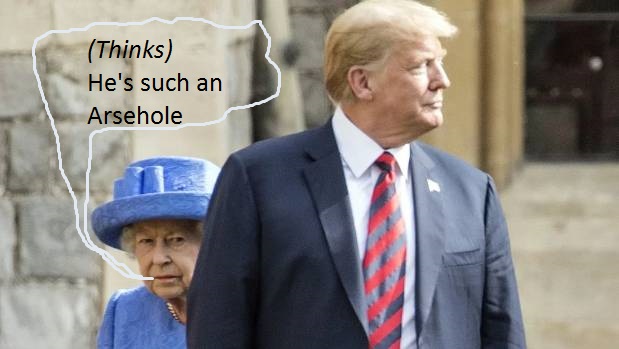
The ongoing bickering and infighting among British politicians over what’s become the banality of Brexit is disgusting enough, but the final straw was witnessing Donald Trump and his legalized doxy parading themselves before the Queen of England at Windsor Castle yesterday.

That the British government could allow it after the abuse Trump has hurled at the U.K. and Europe during his time in the White House, is symptomatic of just how far to the right of politics the Tories have drifted. Their allegiance to the Democratic Unionist Party of Northern Ireland, and affiliations to UKIP (United Kingdom Independence Party), would have been unheard of a few years ago.

I’m sure I’m not the only one breathing a sigh of relief today that Donald Trump has taken himself off to one of his golf courses in Scotland and out of the limelight (hopefully) for a short while.

Nicola Sturgeon, Scotland’s First Minister…

…and one of the few politicians I have any time for, has refused to meet him. She’s also one of the few to stand up to him, and like all bullies he hates her for it. As a former advisor to Theresa May told the Huffington Post:

“He totally hates Nicola Sturgeon. He spends lots of his time bitching about Sturgeon. He loathes [Alec] Salmond too. But why spend so much time talking about Sturgeon in a phone call with Theresa May?” Ms Sturgeon has been a critic of Trump since before his election to the White House, calling on Americans to vote instead for his defeated rival Hillary Clinton.[1]

The Britain I knew only sixteen years ago has changed out of all recognition: politically, environmentally, socially. The treatment of immigrants, the deportations, incarcerations, are on par with those of the U.S.. Large tracts of national parks are sold off to private enterprise, there are more homeless on the streets than ever before. House prices are so high developers buy them for renting to young couples at exorbitant cost with no security of tenure whatever.

The nation’s health service is in chaos. It’s now acceptable if emergency treatment is given within four hours of a patient arriving at an accident & emergency department. Many are left on trolleys or in ambulances much longer than that. Take the case of Albert Thompson…

…who lived in Britain forty-four years and was refused cancer treatment because he couldn’t produce a British passport or pay fifty-four thousand pounds for the treatment.[2] I remember when the NHS would treat anyone who was ill, free of charge. The patient’s welfare was priority. Today, Albert Thompson is just one of many.

Britain is a disgrace that shames me whenever I’m forced to go there. I was once proud to be British. Now I’m embarrassed and ashamed to admit my heritage.

John Cleese is leaving Britain for the Caribbean island of Nevis. If I had his money I’d be there before him.


[1] “Donald Trump ‘hates’ Nicola Sturgeon, ex-UK Government aide claims” The Scotsman, July 13th 2018

[2] “Londoner denied NHS cancer care: ‘It’s like I’m being left to die'” Guardian, March 10th 2018

Only A Six-Spot Burnet

George Monbiot wrote an interesting article in the Guardian recently, entitled “In Memorium”, and available on his blog1. It concerned how we can so easily forget the names of creatures that have grown less common over the years, as consequently we come across them much less frequently.

In his case it was the name of a caterpillar, now virtually relegated to obscurity by intensive farming, overuse of pesticides, and tons of weedkiller, that taxed his memory. The brain tends to file unused items deeper in its vaults, sometimes never to see the light of day again. Recall becomes even more difficult with aging: the name of a caterpillar or wild flower may trip from the tongue at age twenty, only to be perplexingly absent when not needed for the next thirty years.

I sympathise with George, an ardent naturalist as well as an excellent journalist. His article continues to lament the loss, or radical decline, of so many species native to the British Isles, and he outlines the often obvious reasons for their demise, not just in Britain but throughout the world.

He concludes the article by stating:

We forget even our own histories. We fail to recall, for example, that the Dower report, published in 1945, envisaged wilder national parks than we now possess, and that the conservation white paper the government issued in 1947 called for the kind of large-scale protection that is considered edgy and innovative today. Remembering is a radical act.

That caterpillar, by the way, was a six spot burnet: the larva of a stunning iridescent black and pink moth that once populated my neighbourhood and my mind. I will not allow myself to forget again: I will work to recover the knowledge I have lost. For I now see that without the power of memory, we cannot hope to defend the world we love.

But George has failed to realise one vital fact. It’s not just our own failing memories that are at fault here. Those of us who have already lived most of our lives still have many memories ranging from childhood, through adulthood, to seniority. The sum of life’s experiences have provided the memories held in our brains. For me, a love of wildlife from a very young age helped to fuse many related memories into my brain cells, but they will die with me.

Generations past, before our age of technology and social education, such memories were transferred by word of mouth from father to son, mother to daughter, grandparent to grandchild. In today’s world it is rare for a child to have access to such information. Parents are too busy working to spare time for that type of home education, grandparents no longer live under the same roof as their grandchildren, and schools today are particularly bad at disseminating the sort of information once passed on from generation to generation in the home, being more concerned with facts relevant to examination success.

If we were born with the sum of all the knowledge in our parent’s memory already in our brain, we would be a totally different species. But we’re not. Children born in just a few year’s time will no more be able to relate to an orangutan than we can to a dinosaur or a dodo. The sight of a swift drinking in flight…

…or a hen harrier hovering as it searches out prey…

…will be unknown to them. Consequently, they’ll not miss such things. They may come across the creatures in books, even view old video on their computers, but they won’t relate to them because they’ll be gone forever. Their world won’t contain them anymore. After all, I’ll readily admit I don’t miss dinosaurs, or dodos.

That knowledge, that appreciation, will be lost forever, taken to the grave by those of us fortunate to have witnessed such sights and marvelled at the natural wonder and complexity of a world rapidly becoming far less wonderful.


[1] “In Memoriam” monbiot.com, July 2nd 2018

Hosted By A2 Hosting

Website Developed By R J Adams